Funerals

IMG_2773I went to a funeral today.  One of my favorite patients came for his routine appointment yesterday, stood matter-of-factly at the front desk and announced, “R died.”

“What?”

“R died.”

“Are you joking?  What?”

She died.  Unexpectedly, R.  She was his wife of almost 50 years.

My patient seemed unaffected.  He had just been released from the hospital and his wife had just called the day before asking about some of his meds.  She was the kind of wife that sent me typed notes about her husband, dutifully checked his BP daily and logged it for my review.  She always included a list of his meds, as if I didn’t already know them, but just in case.

J is a salty, crusty ex-marine, but with such a gentle side that he always inquires about my children.  He knows their names and their interests.  R, his wife was a lovely woman, always dressed just so, modern with a blush of lipstick.  They were a contradiction in terms.  J was hard and gnarly, R was classy and put-together.

R rarely came to J’s visits.  It was always just J and I joking around.

“Hey Dr. Vass, ever thought about putting a beer machine in your waiting room, I bet you get more business that way.”

“Hey J, you ever think about quitting smoking, you might breathe better that way.”

“Hell no, that’s bullshit.  I’m not quitting, EVER!”

My gnarly, ex-marine patient is now left behind without the woman who softened his hard  edges.  It seems as if the world is out of balance.

I went to his wife’s funeral today and it made me think of funerals in general.  After  a life well-lived they often feel like an afterthought, like the period at the end of the last sentence in an epic novel.  I have been to funerals that have been touching, but somehow they always seem to miss the essence of the person who has passed, the family being too distraught to notice.  The funeral is a place to remember the departed, but it turns out to be simply endured.  Painfully.  Tearfully.  Endured.

A few years ago, my friend was getting married and her Maid of Honor was sick.  She asked me to fill in.  I needed to write a Maid of Honor speech quickly.  I asked J, because he happened to be in my office that particular day for a check up, “What is the secret to a happy marriage?”

Well, let me tell you a story.  I had just gotten into the marines and me and R had just gotten married.  Hell, it was only a few weeks.  I didn’t even know her birthday.  I had to fill out all this paperwork, get all these shots, I didn’t know what the hell was going on.  I had to put down R’s birthday and I didn’t have a goddamn clue what it was, so I made it up.  For the rest of my career in the marines, whenever my wife needed to go to the doctor, when she had our kids, she had to write down the wrong birthday.  So if you want a happy marriage, you better know your wife’s goddamn birthday, because she wasn’t too happy with me after that.IMG_2774

I told that story at my friend’s wedding along with some others that I had collected from patients that day.

I should have stood up at the funeral and told their story, but it’s only now that I remember it.  I wish we could have a month to plan a proper funeral instead of just a few days.  They were married for close to 50 years with a life full of children, grandchildren, love and laughter, the abrasive J and the stylish R, perfectly balanced.


Posted in My Stories | Tagged , , , | 2 Comments

What Ever Happened to Patch Adams? Part 2

clown-1161457-639x961What Ever Happened to Patch Adams?

What DID ever happen to Patch Adams?  I remember the movie, the star, the eccentric character he portrayed, and an idea; humor, laughter, silliness as a form of treatment for medical issues.  That’s just ridiculous.  Where’s the science?  The studies?  Who’s going to pay for this nonsense?

I did what anyone who has a question does these days, I googled it.  I found a website that led me to the answers. http://www.patchadams.org/

Patch Adams is alive and well and he continues to bring happiness to the afflicted around the world.  He continues to dream about opening a free hospital for those that seek his kind of treatment.  Dr. Adams is a busy man, traveling with a band of silly clowns to refugee camps, orphanages, and hospitals all over the world.  The website provided an address.  Dr. Adams answers all letters, it said, so I wrote him a letter and he responded!  Imagine my delight when a package arrived in the mail with 2 books, a video, a newsletter, a handwritten letter, and the answers to the questions I posed!

Dr. Adams writes, “I’ve been at our project obsessively for every day for 45 years  (thinking it would take 4),” he continues, “Every second of the 45 years has been thrilling -and none of the way I thought it would be.”

So we ran a pilot hospital in our home 1971-83, 20 adults, 3 dogs, and our kids in a 6 bedroom house -with 500-1000 people in our home each month with 5-50 overnight guests/night.  Never charged money (we worked outside jobs to pay to practice medicine) -no 3rd party -no malpractice insurance -as a family doctor I gave 3-4 hour initial interviews and visited their homes -and integrated all healing arts -against the law -whee!

After 12 years, I realized we’d have to go public to raise funds -went public -closed doors -and for 31 years I’ve been on the road 300 days/year -81 countries -5 million miles -150 clown trips (to countless refugee camps, etc).

It has all been thrilling every second.  Imagine having 45 years to fantasize about your fantasy hospital?  It’s a humdinger!  I think we’ll be funded soon!  Yahoo!

  1. Were you always a fan of clowns?I love fun -some clowns are fun.  I am a clown who is a doctor
  2. Is laughter truly the best medicine?I think friendship is the best medicine
  3. Do you think the name, Gesundheit Institute was both humorous and a nod to your time as a child in Germany? (His father was in the US military and stationed in Germany)Both -And I’m a scholar of cartoons and Gesundheit is the most used punchline in cartoons -I have >150 cartoons using it
  4. How has the vision of the Gesundheit Institute changed now that you have embarked on a global mission?I’ve had one dream for 45 years -not one day off.  I designed a hospital that eliminates 90% of the cost, where all permanent staff live together as a communal eco-village -eliminating 85% of their environmental footprint, described in my first book, Gesundheit
  5. Do you think the Gesundheit Institute, its plans, its ideals will survive even when you are gone?It has to get built first -then yes it will.   I thought it would all be built in 4 years (1975).  The movie promised to build -gave me nothing
  6. How can parts of the Gesundheit Institute vision/ideals be applied in the current medical system?  Have you seen any examples of this happening?Our current system is a greedy vulgar system -can’t be fixed.  Yes, there are many people who do the best they can in the horrible system -like your pal, Dr. Sortino
  7. What would be the perfect society?  Would it include perfect health?A world free of capitalism -a feminine world -bathed in perfect justice and one for all people-I don’t know what perfect health looks like
  8. Do doctors become doctors to heal others or to heal themselves?  Or both?I think, today a lot of doctors go into medicine for a lucrative job -super sub-specialty so they can be 9-5 -not real doctors
  9. Primary care doctors commit suicide at higher rates that any other profession (used to be dentists).  What can we as doctors do about this?I would never practice in the vulgar universal greed of US big business of medicine-no suicide when the practice is exactly like your fantasy

As I navigate the system that I find myself in, often feeling disgruntled, frustrated, disillusioned, I reflect on Patch Adams’ dream, his fantasy of a free hospital -free of the “greedy vulgar system” in which good doctors and weary patients find themselves.  It inspires me to think a little more outside of the box than I did before.  Thank you, Patch, for inspiring me to be the kind of doctor I want to be -one that finds joy in my work, encourages happiness in my patients, and finds ways to laugh with them in spite of it all.  It’s in those moments of shared laughter that I feel we are a part of something bigger, like a revolution in healthcare.

If you would like to help Patch realize his dream, and if you are also inspired, check out his website, blog, clowning trips, and festivals held at the future site of Gesundheit Institute.

Here are the links:


Photo credit:  Felipe Daniel Reis


Posted in Medical Musings | Tagged , , , , , , | Comments Off on What Ever Happened to Patch Adams? Part 2

Take Two LOL’s and Call Me in the Morning

_DSC0030Has everyone on earth simultaneously become too serious or is it just me?  Doesn’t anyone ever laugh anymore?  Everyone seems so angry, so easily offended, maybe it’s overcrowding, global warming, poisoned water, oppression, illness, or the collective lousy jobs with lousy paychecks.  Maybe it’s the US presidential elections.

It can’t all be doom and gloom in the world, where’s your sense of humor?

I have often heard the expression, “Laughter is the best medicine,” but is it true?  Are we all better off if we just laughed more?

It is difficult to study the effects of laughter, but certain things have been determined.  Laughter in many ways mimics exercise.  It increases heart rate, blood pressure, respiration, circulation.  Laughter dulls pain, decreases blood sugar and increases the immune response.  It certainly sounds like the best possible medicine.

People tend to laugh more with others.  It is not common for someone to laugh alone, at least not as vigorously as they would with a group.  Even if you watch a comedy on TV alone, the laugh track mimics a group of people laughing together and enhances the experience. Laughter may only be a part of the equation.  The benefits of laughter may actually come from spending time with others, forming friendships, and strengthening relationships through shared experiences.

Researchers hypothesize that the purpose of laughter is to bring people together, not necessarily to improve health.  The health aspects come from people being with other people.  All human cultures in the entire world recognize laughter.  It sounds the same in all languages.  It’s universal.  It’s contagious and spontaneous.

It is hard to laugh on purpose.  Try it.  Right now, wherever you find yourself.  Just laugh. Do it.  Thank you, don’t you feel better?  -Probably not.  When it is forced it loses something in translation.  That’s why you feel a little weird right now.  It wasn’t as satisfying as when the laughter is spontaneous and collective.  It just feels better to laugh with others.

Laughter conveys a shared understanding between people.  It enhances marital relationships.  No one ever says, “I want a partner who never makes me laugh.”  Laughter makes us feel good when we are with others so it encourages the behavior of being with others.

I don’t know about you, but there have been moments in my life where I thought I might die from laughing so hard.  Control of bodily functions were lost.  The gasping for breath between whoops of laughter barely keeping me alive.  As “good” as laughter can be for one’s health, could it in high doses be equally bad?  Could someone die from laughter?

I don’t know, I suppose anything is possible.  I will personally take this on as an experiment.  I plan to laugh as hard as I can for as long as I can for the rest of my life until it kills me.  I will tell my patients to do the same.  LOL.


Posted in Healthcare Today | Tagged , , , | Comments Off on Take Two LOL’s and Call Me in the Morning

What Ever Happened to Patch Adams?

IMG_2727

There is this unspoken line that is not supposed to be crossed when you are a doctor, not with your patients, not with the nurses, and not with your office staff.  There is this unspoken line that the doctor is the authority and to be too chummy with anyone in that circle would diminish that authority.  Order, authority, hierarchy, all of these are essential for the doctor to instill a little fear into everyone, staff and patients alike, so that no one questions or defies them.

I have always had trouble with that part of the job.  I think I might have a problem with boundaries.  Not in a weird creepy way, I’m not going to follow someone home.  I just really like to let the guard down.  I like to be friends with my staff.  I enjoy getting to  know my patients, their families, all about their lives and I equally share stories about me and my experiences with them.  I invited patients to my wedding.  I’m friends with my patients on Facebook.  Friends from work have come to my baby showers and my kids’ birthday parties.

There are moments that I wonder, am I being appropriate?  Am I too nice?  Do people respect my authority?  My partner in practice often looks at me with a manly countenance of disapproval, “You stand up for the staff too much.  You are always on their side.”

“You always get higher scores on the patient satisfaction surveys because you are too nice to the patients.”

Jeez.  I must be such a pushover.  I’m too nice.  No one will respect me.  I stand up for the wrong people.  Regular Goody-Two-Shoes.  Typical woman.  Always smiling and laughing.  Why aren’t I more professional?  Stoic?  Angry?  Authoritative?  Full of righteous indignation? Doctor-ish?

I tried being all of those things at first.  I can pull it out of my ass when I need to.  It feels contrived and a bit unleashed, like something pent up and frustrated barrels out of me.  I don’t feel very happy being that way.  I choose another way.  My way.

The first time I met someone else like me was when I did my very first clinical rotation in medical school with Dr. Sortino.  He would sit down beside the patients and talk to them about their lives, he’d tell them jokes, shoot the shit, all the while assessing them, reading through their chart and formulating his plans.  They LOVED him.  I LOVED him.  He  would call me up at night and ask me what color scrubs I was going to wear the next day so that we could match.  He was warm and endearing and he was a great doctor.  He didn’t know it, but watching him early on gave me the permission I needed to be the kind of doctor I wanted to be.

I remember seeing someone else like that.  It would be two years before I started medical school that the 1998 semi-biographical account of the life of Hunter Adams, M.D. AKA Patch Adams came out in theaters.  He donned a clown nose and used humor as an essential part of his therapies.  He dreamed of a different way of being a doctor using equal parts joy, laughter, and happiness in his practice.  After graduating from medical school in 1971, he and a small band of like-minded people founded the Gesundheit Institute, a free clinic that operated for 12 years using happiness as one of the tenets of healthcare.

I hadn’t thought of Patch Adams in years, not until the death of Robin Williams in 2014.  It made me wonder, whatever happened to Patch Adams?  Did he achieve his dreams of a Gesundheit Institute complete with a free hospital, free healthcare, and centered on providing humor, joy, and happiness to his patients?  If he did achieve the dream, was it working?  Could free healthcare and laughter be the answer to the problems facing healthcare today?

What Ever Happened to Patch Adams? Part 2

  1. http://www.patchadams.org
  2. https://en.wikipedia.org/wiki/Patch_Adams
Posted in Healthcare Today, My Stories | Tagged , , , , , | 7 Comments

To You

hello-my-friend-1529130
To You 
my Muslim, Jewish, Gay, Black, and Brown
Brothers and Sisters
I will not hate You
Like a table piled high
with rancid meat
The bounty of the beast
I will not taste
the lies
I will not chew
the bigotry
I will not digest 
the hate
To you who society
tells me
I am better than
only not as worthy 
as my white brothers
I.
Will.Not.Hate.
You.


Photo credit:  Adalberto Tostes
Posted in Poems | Tagged , , , | Comments Off on To You

Running Etiquette

IMG_2570Why Run?

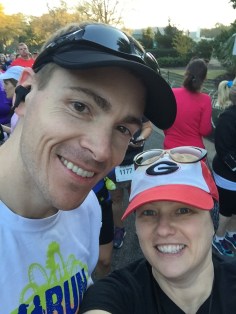
I like to run.  I haven’t blogged about it much, because I’m annoyed with running right now.  My last race (before today) was a half marathon.  It was great, I felt great until afterwards when my left hip started to hurt and it has not stopped for 2 months.  I haven’t run for 2 months until today.

I used to be the runner in the family until I inspired my darling husband to take up the cause.  Now he’s the runner.  I’m not going to pretend that this doesn’t annoy me, because it does.  Running was MY thing.  This happens to me all the time.  If I catch a cold, then everyone in my house has to have a cold and MY cold doesn’t matter anymore.  It’s not fair (Waaaaaa).

My husband is really fast.  He says that he likes to run because it’s something that we can do together.  The only thing we do together is drive to the race and then drive home afterward.  He’s fast and I’m not.  He says the best part about running is passing people.  He called it “the best feeling ever.”  I just look at him, annoyed, a little side eye, really?  I wouldn’t know…

He signs me up for races ALL THE TIME.  If it weren’t for his enthusiasm, I may have given up this running thing a LONG time ago.  I ran in a 4 mile race today and it wasn’t too bad, thank God for muscle memory.  I was definitely in jog mode and not race mode because I’m nursing this left hip, so I was able to look around and observe.  It dawned on me that so many runners haven’t the faintest idea that there is an etiquette to running in a race.  They have no idea that they are being incredibly annoying to the rest of us.

  1. If you are slow, like me, start in the back of the pack.  About 2 minutes before the start of a race, my husband gives me a kiss, and then maneuvers his way to the front of the racers and I maneuver my way to the back.  This is what he refers to as “running together.”  It makes sense, though.  The fast runners are really serious about the race.  There are no tutu’s or costumes in the front.  All that shit would create drag and slow them down.  Slower runners should make way for the faster ones.  They earned it.
  2. If you are walking in a race, that’s totally OK.  I’m not kidding.  Walkers welcome!  Just stay to the right.  Not in the middle, not on the left (maybe in England?), but all the way to the right.  That way the faster runners can easily pass you.
  3. If you and your 20 besties want to sign up for your first 5K, do it!!  Just don’t run/walk arm in arm spreading out across the entire street.  You are adorable with your matching shirts and Superman compression stockings, but you are in the way, even for me, the slower runner.  Move it over to the right, bitches.
  4. If you drop something and stop abruptly in the middle of a huge pack of running humans, you are about to eat pavement and it tastes like defeat.  Secure everything to your body before the race, if your tutu falls off mid race, it’s meant to be.  Leave it and keep moving.  If you HAVE to stop, you better pull over to the right first.IMG_2569
  5. If you are a faster runner, don’t be a douche to the slower ones.  Yes, you are a gazelle, sure-footed, weaving in and out of the masses, but you elbowed me and that guy with CP, nearly knocking him over, so that makes you a douche.  No PR (personal record) is worth taking out the disabled along the way.
  6. Running should be fun, don’t be so serious.  Smile, wear your stupid tutu, your costumes, be cordial to your fellow runners, help someone who falls, encourage the kids, the elderly, but not in a condescending way.  Just be joyful.  When you finish running, you should stand near the finish line and cheer on the slower runners.  No one does this, but more people should.

If it wasn’t for my hip hurting and the fact that I am perpetually slow, I probably wouldn’t be so annoyed with running, runners, my running husband, but I also wouldn’t have put much thought into running etiquette.  You’re welcome.  Now where’s my Ibuprofen?


Posted in Advise Humorous, My Stories | Tagged , , , , , , , | 3 Comments

How Would a Trump Presidency Affect U.S. Healthcare?

old-sweet-woman-1570168-639x958

Experts predict that Donald Trump will win the U.S. Republican Presidential nomination.  Because he is a novice politician, it is difficult to predict how he stands on certain issues.  He has vacillated from prochoice to pro life, antiwar to pro war, pro taxation of the rich, to its opposition.  He has proposed balancing the budget by cutting spending on education and the EPA -because he really likes the poorly educated and apparently a polluted environment. He also threatens to repeal Obamacare.

If Donald Trump is elected President of the United States in November, how would it affect the U.S. Healthcare System?  Here are my predictions:

  1. The Male Hand/Penis Ratio:  Large amounts of governmental research dollars will be funneled into the study of the male hand/penis ratio.  Scientists all over the world will marvel at the breakthrough in technologies that will arise.  It will be the greatest accomplishment of his presidency.  Trump will ensure that all men desiring a penis and/or hand enlargement will get one -free of charge.  Routine screening mammograms will no longer be free, however, because that was an Obamacare thing and he wants to repeal Obamacare.  Men will be able to grab hold of their shortcomings with a renewed vigor and release the load of doubt from their minds if Trump is elected President.
  2. Death Panels:  There will no longer be death panels….except for women over the age of 50.  Who needs those old bags anyway?  They have outlived their usefulness.  Hillary will be the first to go.  Trump wishes these death panels were around prior to his many divorces.  It would have saved him a fortune.  The only drawback is that there may not be enough young, beautiful, statuesque women to fill the gaps in America -you know, the model types.  Trump will make special concessions to allow for models to be shipped in from other countries.  It worked for him.  There will be model-shaped doors in the walls that line the American borders to allow for their easy access.
  3. Frivolous Lawsuits:  Trump loves to sue people.  I don’t like to talk about lawsuits because doctors get sued all the time for lots of money.  This probably won’t change under a Trump presidency.  Lawsuits will remain a staple of the American way.  Lawyers collectively rejoice.  Scoundrels.
  4. Walls:  Trump has a thing for walls.  Walls keep stuff out.  I heard that Trump has an alleged germ phobia.  This calls for some walls to be built.  Put anyone with anything contagious behind it.  Those with the flu, strep, HIV, ringworm, scabies, toenail fungus, lice, Ebola, Zika virus, pretty much anyone with anything.  Walls all over the damn place.  Walls around hospitals, clinics, and around the White House.  Walls with model-shaped doors, because hot chicks get sick, too, but they can also get better and will need to get back in.
  5. The End of Psychiatry As We Know It:  Renowned Psychiatrists have ventured to guess based on Trump’s public comments that he may suffer from Narcissistic Personality Disorder.  Consider for yourself that a narcissist is a person that has an exaggerated sense of their own importance, a sense of entitlement, they desire adoration, and believe that others are envious of them.  Well, forget I mentioned any of that, because when Trump is elected president, Psychiatry will be banned, the DSM-V will be burned, and Narcissistic Personality Disorder will cease to exist as a Psychiatric disorder.  This would also serve the dual purpose that his supporter’s mental afflictions will remain undiagnosed.

Trump has turned the Republican Presidential nomination process into a 3 ring circus.  People who support Trump often say its because he says what he thinks.  Yeah, that’s what worries me.  He says a lot, often contradictory, inflammatory , and divisive.  His intentions for the United States are only truly known to him.  The healthcare industry is already in a tenuous position and deserves a President with a specific and carefully considered point of view, not one whose positions change haphazardly.  The American people deserve a President with giant hands -anyone taken a look at Hillary’s hands?  Huge.  Bernie’s no slouch, either.


Photo Credit:  Marialucila Gomez


Posted in Healthcare Today, Medical Musings | Tagged , , , , , | 2 Comments

Spirit Animal

hummingbird-flying-1385456-640x480We sat across from each other, my laptop resting on the exam table while I explained the intricacies of her lab values.  Nothing was amiss.  She was in relatively good health despite having diabetes and breast cancer.  She listened intently.  Her face softened while I commented on her “perfect Hemoglobin A1c.”

She straightened her long skirt that dragged the floor when she walked.  She looked at me warmly with a sly smile on her face.  Dr. Vass, she said, I just realized what your spirit animal is do you want me to tell you?

I laughed, a little surprised at the strange request.  OK.  I’ll play along.  What’s my spirit animal?

You are a hummingbird.  You flitter about, happily, moving from one room to another like a hummingbird visiting the flowers.  I love to watch the hummingbirds, they make me so happy.

How delightful.  I’ll take it.  What exactly is a spirit animal?  A spirit animal is a creature that embodies certain personality traits of a person.  Someone’s spirit animal can also be one that they would aspire to be more like, i.e. embody courage, steadfastness, intelligence.

Inspired by the conversation, I decided to give my husband, children, and best friend a spirit animal.

  1. Husband:  A deer.  A deer is strong and mighty, but not fierce.  It’s power is not found in its ability to claw or tear with its teeth.  It is patient, curious, but cautious.  It is quick-footed and gentle.
  2. Son:  A chimpanzee.  Intelligent.  Spirited.  Silly.  A chimpanzee has the ability to be fierce, but prefers a happier existence of lying around and socializing.
  3. Daughter:  A cat.  Cats lounge around the house, find a sunny spot on the floor and curl up in a ball.  They also get to decide who pets them and when.  They usually enjoy their own company and seek out affection from a chosen few.  They are mysterious.
  4. Amber:  A dolphin.  Dolphins are sleek and playful, but serious and focused.  They can kill a shark when necessary, but they are helpful, joyful, and balanced.  They swim and breathe air.  They master two worlds.

What’s your spirit animal?  Need help deciding?  Here’s a website that I found helpful.

Spirit Animal


Image credit:  Santiago Cornejo

Posted in My Stories | Tagged , , | 2 Comments

Teaching Doubt

Christmas 2009 029Dr. G motioned toward the small upholstered seat in his office.  I obliged and sat down while he walked around his oversized mahogany desk and sat in his black leather chair.  How many patients sat here, nervous, uncertain, looking at their all-knowing doctor sitting in that large foreboding black leather chair waiting for the news.

I wasn’t waiting for anything.  We had just finished clinic and we sat down quietly to discuss the cases.  He told me stories about his time in the Amazon rainforest.  Truthfully, I didn’t believe a word he was saying.  He didn’t look like the kind of guy that would spend anytime away from a hairdryer.  His hair was always perfect.  Too perfect.  He obviously dyed it jet black.  He dressed like Simon Cowell (before there was a Simon Cowell).  Tight black v-neck shirt.  Black slacks.  Black belt.  Very expensive black loafers.

He talked about the time he diagnosed Chaga’s Disease in the jungle, a disease I read about, but would likely never encounter in my entire medical career.  I racked my brain for details, in case he asked me a question, toxic megacolon, some kind of kissing bug.  He sat back in his oversized chair, elbows resting on the arms, hands folded under his chin, looking out into space, and across time.  He wasn’t in the rainforest now.  He was in the city with a clinic full of patients with the typical American ailments; diabetes, hypertension, cancer.

I made certain assumptions about Dr. G after working with him for close to a month.  He was older than he wanted to appear, he was unmarried, never had any children, drove a fancy car, and dated the drug reps.  He wasn’t particularly charming or friendly to the patients, but he was knowledgable, direct, and confident.  He treated me like a colleague, which I appreciated, since I hadn’t yet earned it.

Two things stuck with me from my time with Dr. G.  One of which broke my heart.  As we sat across from each other in his office, he leaned forward, elbows now on his desk, hands still folded, but now in front of him.

If I leave you with anything, Kim, it’s this:  know your medicine, know your diseases inside and out.  You have to know them so well that if you get a call at 2 in the morning, if you are startled out of a deep sleep, you can function, you can treat anything on the other end of that phone, you have to know it as well as you know yourself.  If you can’t do that, if you have fear, you better turn around right now.  You better stop right now because you will hurt somebody.

That certainly got my attention.  It became something of a mantra to me.  Know the medicine.  Know the diseases.  Call at 2 am.  Hurt somebody.  Later, when I was on call in residency, I would remember his words.  I trained myself to wake from sleep instantly, from fully asleep to fully awake at the buzz of a beeper.  Ready to go.  Know the medicine, know the disease, because I didn’t want to hurt anybody.

Towards the end of my time with Dr. G something happened.  His partner obviously irritated him.  His partner was sloppier, friendlier, happy-go-lucky, and lazy in comparison.  I could sense the tension.  Years later, I learned that the partnership had dissolved, although when that actually occurred is unclear.  I think I was witnessing the beginning of the end.  Dr. G even started to look a tad disheveled, which was so unlike him, his black hair rooted in gray, his black shoes a little scuffed.  After a particularly busy day, we sat like we always did in his office.

All the smart people coming out of school go into business.  There’s no money to be made in medicine.  Why would you ever want to do this?  You should go to business school.  This isn’t worth it.  Patients want to sue you, insurance doesn’t want to pay you.  Medicine is not what it used to be.  You should get out now. Medicine is a mistake.

No one ever said that to me before, that I may be making a mistake.  My heart sank.  I never once considered it until that moment.  It didn’t feel like a mistake.  It felt like what I was supposed to be doing.  Going to business school would feel like a mistake.  In that moment, he gave me doubt.  A doubt that once in a while still visits me.  Was it all worth it?  Should I have chosen another way?  Did I do the right thing?  All that money that I owe for medical school…

I wish I could sit across from Dr. G today, me in that small upholstered chair, him in his big black leather chair.  I would sit forward, elbows on his desk, hands folded under my chin, look him in the eye and say, Dr. G, it has been worth it, every minute, every sleepless night, every penny that I have spent for my education.  All worth it.  If I could leave you with anything, Dr. G,  it would be this, to truly see someone, connect with them in their most desperate moments, to bring them comfort, to ease their pain, that is why we do this job.  Not for the money.  Like when you were in the Amazon.  I wish you could see that for yourself before your own doubt destroys you.


Posted in Medical Musings, My Stories | Tagged , , , , , | 2 Comments

Guns N’ Doses: US Healthcare and the Gun Debate

OLYMPUS DIGITAL CAMERAI’d like to clear things up a little before I even begin this topic:  the Second Amendment to the Constitution of the United States of America is NOT going anywhere.  No matter what.  That means you get to keep your guns you lunatics.

There are people out there, I am sure, that want to take your guns away.  There are some that wouldn’t mind if somehow those guns would turn on you, like a jilted lover, because in essence it seems that you are enamored of the gun.  Guns have their place.  They give a sense of security.  They can be used to hunt for food.  They can be used for defense.

Americans like guns.  We have a constitutional right to own them, but what about the public health concerns associated with gun ownership and use?  Is it a valid concern?  Much like the public’s concern for clean drinking water, clean air, healthy food, and safe medications, does the government and those in the healthcare field have a duty to study and regulate the use of guns?

The “Dickey Amendment,” a provision within a bill passed by the US Congress in 1996, and fully supported by the NRA, prohibits government funding to research gun violence in the US.  That means that the CDC can not study the affects of gun violence in the community, the use of firearms among different cultures, genders, mental health issues and gun ownership, or ways to prevent gun violence.  Nothing.  It was in direct response to research published in 1993 by the division of the CDC known as the National Center for Injury Prevention, that showed that gun ownership increased the risk of homicide in the home.  The Dickey Amendment redirected >$2 million away from gun violence research for the next 20 years.  In 2011, similar restrictions were applied to the NIH at the urging of the NRA.

Medical professionals on the front lines of the aftermath of gun violence issued a call to action in April of 2015.  They have demanded a concerted effort by the government to research gun violence and institute guidelines.  These professionals include:

  • The American Academy of Family Physicians
  • The American Academy of Pediatricians
  • The American College of Emergency Physicians
  • The American College of Surgeons
  • The American Congress of Obstetricians and Gynecologists
  • The American College of Physicians
  • The American Psychiatric Association
  • The American Public Health Association
  • The American Bar Association

In essence these groups of healthcare providers and lawyers expressed the need for research, mental health and background checks for firearm purchases, a ban on assault weapons, and the ability to discuss the dangers of guns with patients.  They also advocated for a fair and confidential way to assess someone prior to labeling them as dangerous and removing their right to own a weapon.  In no way were any of these organizations advocating for a repeal of the Second Amendment.  You get to keep your guns.  Healthcare providers and lawyers just want to make everyone safer.

How are we, as physicians, as Americans, able to make sound decisions, or offer sound advise on a subject that has not been scientifically researched in over 20 years?  The mere fact that a ban has been applied to government funded research on gun violence, makes one wonder what is being hidden and what is being covered up?  There once was a time when no one knew the dangers of drinking and driving, smoking cigarettes, or the harms of drugs in pregnancy. That was a time before research, government-funded research, research by the CDC and other organizations.

The public deserves to know the inherent harm in owning a gun.  At this time, I would have to side with the pro-gun enthusiasts, though.  What’s all the fuss about?  Why is everyone trying to ban guns?  Most people who own guns are upstanding citizens wanting to protect their families.  We have no facts to say otherwise and it’s time that we get the facts.  If we are going to have a real debate about guns, shouldn’t we have all the facts?  It’s time to lift the ban on research and uncover the truth.

Photo credit:  Ozan Uzel


Posted in Healthcare Today | Tagged , , , , , , , | Comments Off on Guns N’ Doses: US Healthcare and the Gun Debate